
Celebrating Breakthrough Ideas: Brook & Beyond Highlights Stony Brook Entrepreneurs
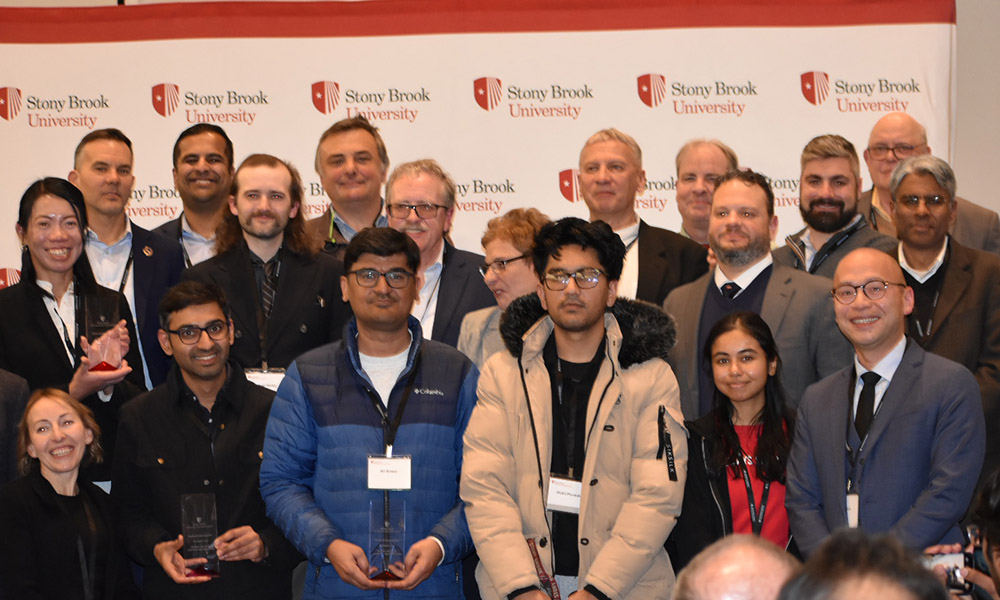
Stony Brook University celebrated its growing culture of research-driven entrepreneurship
at the Brook & Beyond Championship Finale, in which eight faculty-led teams ended a two-month innovation
sprint by pitching their ideas to a panel of industry experts.
The December 5 finale marked the conclusion of Stony Brook’s inaugural flagship innovation
program, designed to help faculty researchers translate high-potential discoveries
into products, startups and solutions ready to solve societal challenges. Held at
the Center of Excellence in Wireless and Information Technology (CEWIT) and sponsored by the Office for Research and Innovation, the event recognized the technologies moving from campus labs toward real-world
impact.
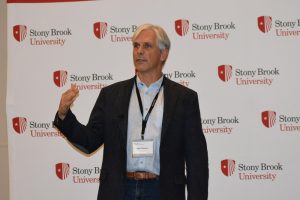 Kevin Gardner, vice president for research and innovation, framed the program’s purpose
in the broader mission of the university. “I think about research and innovation as
the discovery of knowledge and then translating that knowledge to have some kind of
impact in the world,” he said. “It does not have to be a technology or a widget. It
can be a curriculum from a discipline. It can be anything that helps people.”
Kevin Gardner, vice president for research and innovation, framed the program’s purpose
in the broader mission of the university. “I think about research and innovation as
the discovery of knowledge and then translating that knowledge to have some kind of
impact in the world,” he said. “It does not have to be a technology or a widget. It
can be a curriculum from a discipline. It can be anything that helps people.”
Gardner described innovation as an enterprise that blends creativity, problem-solving and community engagement, and listed examples from his previous institutions to illustrate how unexpected ideas can grow into meaningful ventures, including a nonprofit initiative that created hats to support wounded veterans. “I think about innovation as how this university impacts the world through our knowledge creation, through our new inventions,” he said. “The Brook & Beyond program is the flagship program that finds those, helps the inventors move those down the pipeline to make it out into the real world.”
After a day of private group presentations in front of the VIP judges, attendees gathered for the public pitch showcase, where teams delivered rapid one- to two-minute presentations highlighting their technologies in medicine, clean energy, advanced materials and environmental engineering. The judges included industry leaders from AI, biotech, medical devices and data science, each evaluating the projects for innovation, feasibility and market potential.
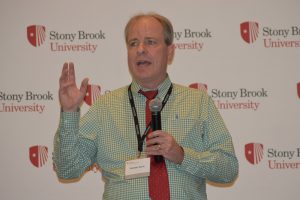 Stony Brook Chief Innovation Officer Michael Kinch described the Brook & Beyond program
as a new chapter for Stony Brook’s research ecosystem. “People ask, ‘what is innovation?’
It is taking the ideas in the university and turning them into something that impacts
the real world,” he said. “It can be for profit, it can be nonprofit. We are agnostic
to that.”
Stony Brook Chief Innovation Officer Michael Kinch described the Brook & Beyond program
as a new chapter for Stony Brook’s research ecosystem. “People ask, ‘what is innovation?’
It is taking the ideas in the university and turning them into something that impacts
the real world,” he said. “It can be for profit, it can be nonprofit. We are agnostic
to that.”
The inaugural cycle exceeded expectations, Kinch noted. “We got 64 applicants, and from that group selected eight finalists. This is our first time and we had to kind of build the plane while we were flying it. I didn’t know what to expect, but it went really well.”
Kinch credited that success to strong faculty engagement and the structure of the program, which includes training modules, mentorship and milestone-based funding designed to mirror real-world investment models. “We are adopting a real-world approach to get everybody used to it,” he said. “Investors want to make sure you are making progress. That is why we use milestone funding.”
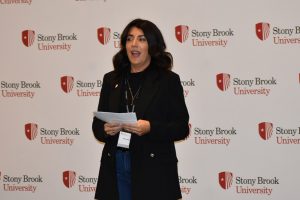 Director of Innovation and Entrepreneurship Hannah Estes discussed the scale of the
first-year effort. “When I first got to Stony Brook, there was no question that there
was groundbreaking research,” she said. “This research needs a bigger stage.” She
credited her team, including coaches and partners in tech transfer, for evaluating
the large applicant pool and preparing the finalists. “These were life-changing, life-saving
projects. It was very competitive,” she said.
Director of Innovation and Entrepreneurship Hannah Estes discussed the scale of the
first-year effort. “When I first got to Stony Brook, there was no question that there
was groundbreaking research,” she said. “This research needs a bigger stage.” She
credited her team, including coaches and partners in tech transfer, for evaluating
the large applicant pool and preparing the finalists. “These were life-changing, life-saving
projects. It was very competitive,” she said.
The finalist pitches reflected the diversity of research emerging from Stony Brook’s labs.
Current Edge presented a modular power electronics unit designed to serve as an adaptable energy hub for renewable systems and data centers. Fang Luo, SUNY Empire Innovation associate professor in the Department of Electrical and Computer Engineering, described it as “one brick for all missions” due to its flexibility and efficiency.
Neuro Monitor, led by SUNY Empire Innovation Professor in the Department of Biomedical Engineering Ulas Sunar, introduced a noninvasive continuous monitoring system for intensive care units that integrates blood flow measurements with EEG analysis to better assess neurological states in critical patients.
The Hand Arthritis Team, one of the night’s winners, is repurposing an FDA-approved drug to treat thumb
osteoarthritis. Marie Badalamente, MD, professor of Orthopaedics, described the urgency behind the work. “Base of the thumb osteoarthritis often affects
both thumbs, is severely painful, and greatly affects normal hand function. Current
conservative treatments are short acting and lacking in evidence” she said. “We have
developed a novel treatment method using a drug encased in microspheres, when injected,
relieves pain and restores hand function in the longer term.” Their treatment, already
in FDA-regulated clinical trials, aims to provide lasting pain relief for a condition
that affects millions.
Another winning team, Hydrogen From the Air, unveiled a first-of-its-kind direct humidity electrolyzer capable of producing hydrogen
from atmospheric moisture. “We are just crazy enough to try to make hydrogen from
air,” said Associate Professor of Mechanical Engineering Dimitris Assanis. “It is not science fiction. We are using novel nanomaterial and
four patented processes.”
 The EtCO₂ Monitoring System team proposed a low-cost, high-fidelity capnograph for use in low-resource healthcare
settings, where access to standard monitoring technology remains limited. Jonathan
Oster, MD, clinical assistant professor in Anesthesiology and director of Global Anesthesia
and Critical Care, emphasized its potential global impact. “We can roll out a device
without disposables and try to put it into facilities that need it most,” he said.
The EtCO₂ Monitoring System team proposed a low-cost, high-fidelity capnograph for use in low-resource healthcare
settings, where access to standard monitoring technology remains limited. Jonathan
Oster, MD, clinical assistant professor in Anesthesiology and director of Global Anesthesia
and Critical Care, emphasized its potential global impact. “We can roll out a device
without disposables and try to put it into facilities that need it most,” he said.
The High Voltage Supercapacitor team, also among the winners, presented a new approach to energy storage that merges high voltage and high capacity, backed by longstanding industrial partnerships. “The project will develop high-voltage, high-power energy storage technology with applications in automotive, grid, and defense,” said team lead Vyacheslav Solovyov, associate director of Technology and Energy for the Office for Research and Innovation. “The solution is a low-cost supercapacitor unit with inherent cell balancing, which allows for operation at voltages at least 100 times higher than state-of-the-art units.”
“If funding is provided, we could move from the Lab Prototype to Commercial-Ready Unit, demonstrating an operable, self-contained unit that proves technical viability and commercial readiness,” added team member Vladimir Samuilov, research professor in the Department of Materials Science and Chemical Engineering. “We will accomplish prototype engineering, design optimization, manufacturing, assembling, testing and validation, performance testing under variable external parameters and data collection on efficiency, durability and scalability.”
The final award went to Clean Water Tech: Low Nitrogen Septic, a team tackling Long Island’s nitrogen pollution crisis with an affordable retrofit for standard septic systems. “Our innovation can upgrade an existing tank into a low nitrogen system that outperforms all current technology at half the cost,” said Thomas Varley, watershed manager for the Center for Clean Water Technology. “The award funding will help us advance this technology to receive approval for installation in residential homes to address Long Island’s nitrogen pollution problem.”
Rounding out the finalists was TrueGait, a project from the Renaissance School of Medicine and Department of Biomedical Engineering focused on improving gait analysis tools in both clinical and preclinical research to better predict therapeutic outcomes.
The four winning teams will receive milestone-based funding and continued mentorship as they advance toward commercialization.
Estes closed the evening by looking toward the future of the program. “We are in a new era at Stony Brook,” she said. “There are phenomenal lab-to-market opportunities, and we would love for you all to be a part of it.” She reminded attendees that applications for the next cohort will open soon. “Spring Cohort 2026 starts very soon. Keep an eye out.”
Kinch echoed that sentiment. “We are going to do this again, and again, with the idea of creating an innovation culture,” he said. “Every time we do this, we will get a little bit better.”
“We are here to help ideas grow,” said Gardner. “Programs like this show what is possible when we support our people and push knowledge beyond the university.”