Advancing Clean Tidal Energy Through High-Fidelity Simulation
Stony Brook Researchers Partner with Verdant Power to Model the Future of Marine Renewable Energy
Researchers at Stony Brook University are helping chart the course toward a cleaner energy future beneath the surface of the Long Island Sound.
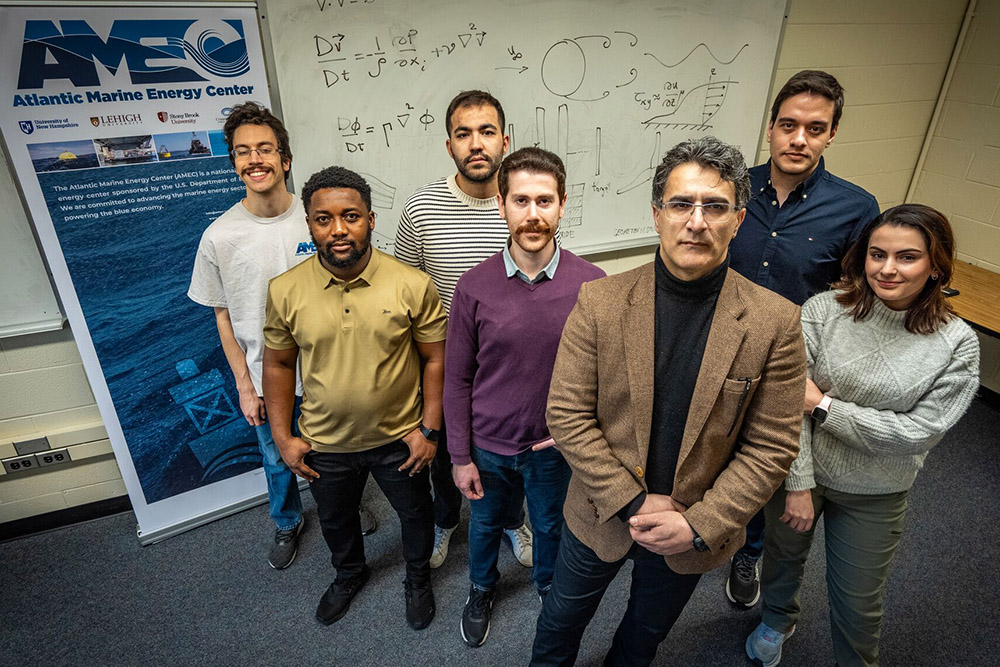
In partnership with Verdant Power, a New York–based renewable energy company, working with the Advanced Energy Research and Technology Center (AERTC), a New York State Center of Excellence, Associate Professor Ali Khosronejad’s research team from the Department of Civil Engineering is leading a project to model and optimize the next generation of marine hydrokinetic turbines. These devices are designed to capture the immense and predictable power of tidal currents, transforming moving water into a reliable source of clean energy.
“The Advanced Energy Center has a long history with Verdant, and their current technological needs aligned perfectly with the outstanding capabilities of Ali and his team,” said David Hamilton Sr., director of corporate engagement for the Office of Research and Innovation. “This project shows how Stony Brook can collaborate with our industry partners at critical times in their strategic growth to help drive innovation and commercial success. Both parties have come together for this project in an inspiring way that leverages each other’s strengths, and I have no doubt will result in the development of a unique and impactful solution to capture the energy of marine environments.”
Harnessing the Power of the Tides
“Tidal energy works on the same principle as wind energy,” Khosronejad explained. “But instead of air, we’re dealing with water, which has a density a thousand times greater. That means the potential for power generation is also much higher.”
Verdant Power, one of the few companies in the United States with a long history in marine energy technology, has developed a new turbine design that could make tidal power more efficient and economically viable.
Deploying large turbines in real marine environments, however, is complex and costly. That’s where Stony Brook’s expertise enters. Using high-fidelity computational modeling, Khosronejad and his team can recreate the physical and environmental conditions of the Long Island Sound in a virtual testbed, an exact digital twin that allows for testing and fine-tuning turbine performance before installation.
“We’re simulating everything: the turbine geometry, the water flow, the sediment movement and even the interaction of the device with the seabed,” said Khosronejad. “This allows us to evaluate performance, environmental impact and cost-efficiency without ever going into the field.”
A Model for Sustainable Innovation
The research builds on Khosronejad’s role in the Atlantic Marine Energy Center (AMEC), a U.S. Department of Energy-funded consortium of universities advancing marine renewable energy technologies. Through AMEC, Stony Brook collaborates with Lehigh University, the University of New Hampshire and Coastal Studies Institute of North Carolina to study, among others, devices that harness energy from tides, waves and ocean currents. The Verdant Power collaboration aligns with AMEC’s mission to accelerate the development and deployment of marine energy systems along the U.S. East Coast.
“This collaboration reflects what we do at our best,” said Abdelrahim Brown, center director for AERTC and the Center for Grid Innovation Development and Deployment (GrIDD). “Verdant had a real need, and Ali and his team brought the kind of depth and discipline that can actually move an idea forward. When industry and university teams work side by side like this, we create a path that is practical, scalable and genuinely useful. That’s the kind of work that strengthens our region and contributes to a more resilient energy future.”
At the core of the project is high-fidelity numerical modeling, a computational approach that integrates real-world data — from water velocity measurements to seafloor topography — to simulate turbine performance with extraordinary precision. “Running these simulations requires supercomputers with hundreds or even a thousand CPUs working continuously for weeks,” Khosronejad said. “The result is a realistic, three-dimensional picture of how turbines will behave in complex ocean environments.”
Unlike small-scale lab experiments, which require physical models and scaling factors that can distort results, numerical modeling allows Khosronejad’s team to study systems at full scale. “We don’t have to shrink the physics to fit a laboratory,” he said. “That means what we learn in simulation is directly applicable to the real world.”
Understanding Environmental Impact
Beyond performance, the Stony Brook simulations are helping Verdant Power and policymakers assess potential environmental effects. Khosronejad’s model can capture sediment transport and seabed changes caused by turbine deployment, key factors in ensuring ecological balance. “Our model doesn’t just simulate water and turbine interactions. It also tracks how sediments move around and how the topography of the Sound might change,” he said. “This allows us to evaluate environmental impacts early in the design phase, well before deployment.”
Such insights are critical as federal and state agencies expand support for clean marine energy. “The Department of Energy wants universities to partner with industry to advance these technologies,” Khosronejad said. “This collaboration helps the U.S. move toward energy security by diversifying renewable sources beyond solar and wind.”
From Simulation to Commercialization
The project began in early 2025 and will continue through Summer 2026. For Khosronejad, success will be measured not only in accurate results but also in real-world outcomes. “Our findings will inform Verdant’s design decisions — how to make the turbine more efficient, more affordable and ultimately ready for commercialization,” he said. “It’s also an invaluable opportunity to train my students to use advanced simulation tools that will define the next generation of renewable energy research.”
While the funding is modest compared to his larger DOE projects, Khosronejad views this partnership as a vital step in connecting academia and industry. “This is about impact, not just research,” he said. “If our results help Verdant Power fine-tune their technology and bring tidal energy closer to market, that’s a win for everyone.”
The collaboration was made possible through the AERTC, which serves as a catalyst for partnerships that translate research into real-world solutions. By connecting innovative companies like Verdant Power with leading Stony Brook researchers, AERTC fosters an ecosystem where ideas move efficiently from concept to commercialization. “Our role is to bridge the gap between academia and industry,” said Hamilton. “This project demonstrates how AERTC can help companies accelerate technology development while providing faculty and students with meaningful opportunities to apply their expertise.”
The Future of Marine Energy
As the world seeks to decarbonize its energy systems, Khosronejad sees tidal power as a key yet underused resource, especially for coastal regions and isolated communities. “There are places in Alaska that still rely on diesel flown in by airplane,” he noted. “A single turbine in a nearby river could power an entire community sustainably. That’s the kind of change this technology can bring.”
Khosronejad is optimistic that projects like this will help the U.S. catch up with international leaders in marine energy, such as the U.K. and Japan. “We’re laying the groundwork for a future where ocean energy becomes a major part of the renewable portfolio,” he said. “With the right partnerships and continued innovation, marine energy could become a powerful contributor to both clean energy and national security.”