


Course Level Assessment Planning
Planning a learning assessment for your course is a cyclical, multi-step process. It involves setting course goals and learning objectives, aligning your objectives with course learning activities and assessment methods, collecting and analyzing data, and closing the assessment loop by making changes to the course to improve student learning.
Teach a general education course?
Complete CELT's Self-Paced Resource Guide on Assessing the SBCs.
The Course Assessment Cycle
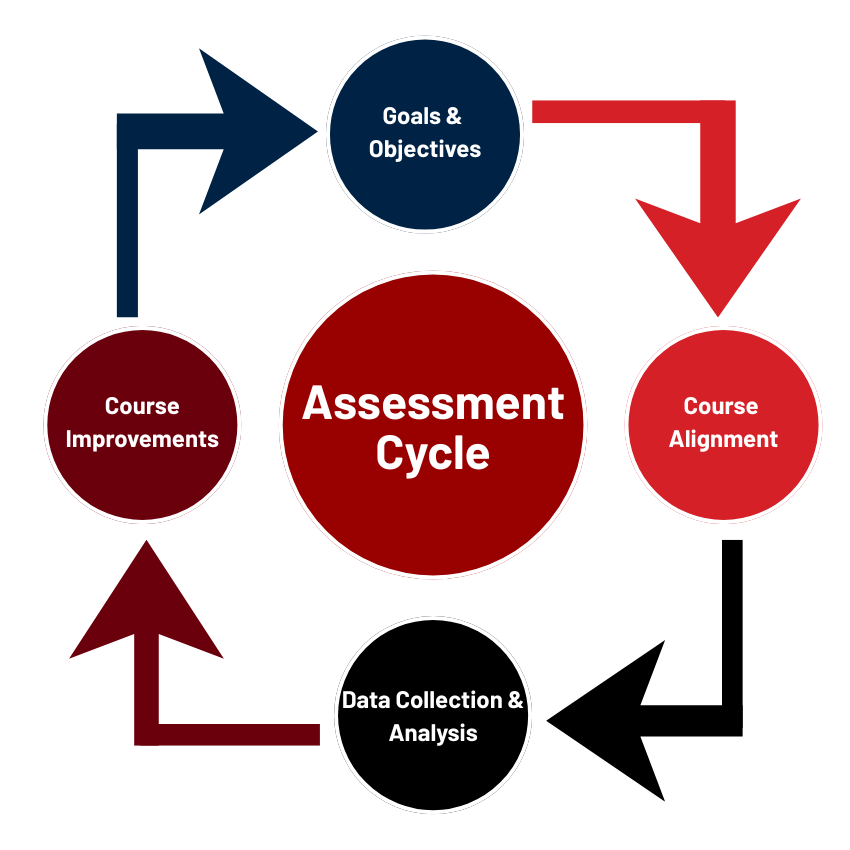
The assessment process is a cyclical one involving the four steps of goals and objectives, course alignment, data collection & analysis, and course improvements.
Course alignment is a design process that ensures learning objectives, assessments,
and course learning activities are all well linked. The learning objectives you craft
will drive your choice of formative and summative assessments, which will then determine
which learning activities you plan for class time. Making this connection clear and
explicit for your students helps to reinforce your course organization, effort in
design, and the relevance of assignments and activities. Learning Objectives ⇒ Evidence & Assessment Methods ⇒ Instructional Resources & Learning
Activities How do I know what assessment methods to use? Collecting Assessment Data Collecting data for the purposes of a learning assessment involves more than just
assigning a course grade for your students. Therefore your assessment methods and
course assignments should be developed to align with your course objectives (refer
to step 2 for more information). Assessment data collection can involve both direct and indirect measures. Direct assessment… Indirect assessment… Data Analysis & Interpretation Analyzing and interpreting data may seem like a large undertaking. However, the process
is simpler if you have already considered and defined criteria for successful learning
on each of your objectives. Here are some guiding questions that can help you through
the process of setting these criteria: Keep in mind these questions may differ based on the assessment methods you selected
for each of your learning objectives. However, once you have answered questions such
as the ones above, you will be able to determine which student learning outcomes met
each of your course objectives, and the percentage of students who successfully learned
each of your objectives. When interpreting your data, perhaps you observe the overwhelming majority of students
demonstrated learning on one course objective, but only half were successful on another
objective. You can use this information to make improvements to the course - whether
that means adding a mid-semester review of certain concepts (i.e., in formative assessment),
or making changes to your course activities for the next semester you teach (i.e.,
in summative assessment). Assessment is a cyclical process! The main value of assessment is using the information to improve the student learning
experience. Therefore, after collecting and interpreting data, it is important to
close the loop by making adjustments to your course(s). Keep in mind that the assessment process
can reveal opportunities for change whether students met your minimum criteria for
successful learning or not. Below are some questions for you to consider in each of
these situations. When students demonstrate successful learning on a given objective: When students do not demonstrate successful learning on an objective: Responses to the questions above will help you conceptualize potential course modifications.
Writing up an assessment report summarizing your findings and recommendations is also
good practice. Keep in mind you do not need to work through this process alone! Faculty
are always welcome to meet with CELT to discuss modifications to their course design(s)
and/or assessment method(s).
Steps in the Assessment Process
Goals are aspirational statements that set the larger picture of the course for you
and your students.
Guidelines for writing course goals:
Student Learning Objectives
For more information about student learning objectives, complete our self-paced resource
guide on Creating Learning Objectives.
Course Alignment Tool