


Rojae Mighty
Undergraduate Recipient 2026
Department of Physics & Astronomy
Myth and Matter: Exploring Early Explanations of Nature
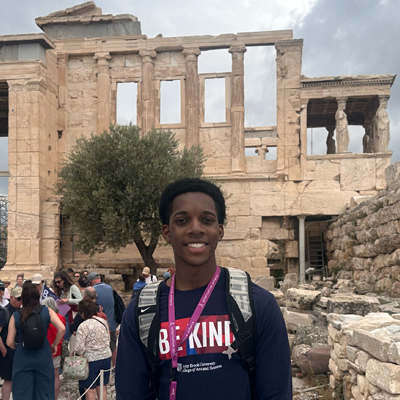
Doing physics research, I am surrounded by how people seek to understand the world through observation, evidence, and scientific reasoning. Before traveling to Greece, the country was mostly synonymous with the myths I had encountered in media. My interest in Greek mythology came from reading the Percy Jackson series and playing the God of War games. Through those experiences, I gained an appreciation for Greek mythology and was always excited when I recognized references to it elsewhere. This fellowship gave me the opportunity to connect a collection of ancient stories to real and lived-in places where mythology, history, and modern society continue to intersect. More importantly, I began to understand that while science and mythology answer questions in different ways, both emerge from the same human desire to make sense of the world around us.
One of the experiences that shaped this realization most was visiting the Temple of Olympian Zeus in Athens with an archaeologist as my guide. Standing among the towering ruins, I listened to the story of Deucalion and Pyrrha, a myth that sought to explain humanity’s origins after a great flood. Standing beside the ruins of a temple dedicated to Zeus challenged my initial view of myths as entertainment. For the people who told these stories, mythology was not simply entertainment. It was a way of answering questions that every society eventually asks: Where did we come from? How did humanity begin? Why does the world exist as it does? Hearing the story in the place where generations once worshipped made it easier for me to understand mythology not as fiction, but as an early attempt to explain the unknown.
This realization followed me throughout the trip. At the Acropolis, I learned the story of Athena giving the olive tree to the Athenians, which, according to mythology, led to the city being named in her honor. I found it interesting that the myth traces the origins of Athens’ name and the importance of olives in Greek society. The tree at the Acropolis today is not the original, but it continues to be preserved because of what it represents. The olive tree remains a powerful symbol of Greek culture and identity, and olives themselves are still an important part of the country’s agriculture and cuisine.
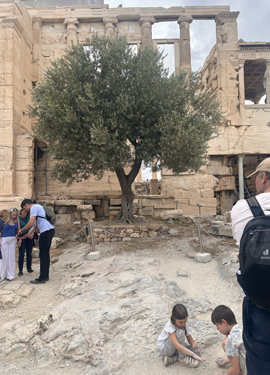
Whether the story literally occurred was less important to me than what the tree represented. It symbolized values that helped shape Athenian society and connected generations of people to a shared cultural story. Modern Greeks no longer worship Athena, yet the story remains meaningful. Its importance comes not from religious belief, but from the role it continues to play in preserving cultural memory. In that moment, I began to appreciate that mythology was not only a way of explaining the world, but also a way of defining community and identity.
Another experience that stayed with me was visiting Mount Olympus, the home of the gods. Standing at the foot of the mountain, with only the myths as my context, I found myself admiring the creativity of the ancient Greeks to take this enormous mountain and imagine it as the home of the gods. Looking up at Olympus, towering over the surrounding landscape, it became easier to understand why people associated the mountain with divine power. The experience reminded me that human beings have always looked to the world around them for answers. Today, science provides tools for understanding natural phenomena through evidence and experimentation, while ancient societies relied on mythology. The methods were different, but the motivation was similar. Both begin with curiosity.
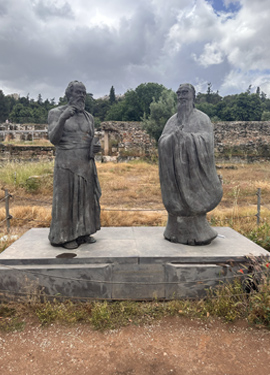
Beyond the myths themselves, one of the most meaningful lessons I took from Greece came from observing how carefully its history is preserved. During a conversation with my tour guide, I asked why more of the Acropolis had not been reconstructed. She explained that preservation laws are designed to protect the site’s historical authenticity and prevent large-scale reconstruction based on speculation. Until that moment, I had viewed the ruins from a perspective of looking at what was missing. Her explanation encouraged me to think differently.
Preservation is not always about restoring something to its former appearance. For these ruins, it is about protecting what remains so that future generations can form their own connection to the past.
That conversation stayed with me long after I left Athens. Throughout the trip, I encountered examples of a society actively preserving not only its monuments, but also the stories, traditions, and cultural memory attached to them. The sites I visited were important not simply because of their age, but because they continue to connect people to the ideas and experiences of those who came before them.
I traveled to Greece expecting to learn about mythology and ancient history. I returned with a deeper appreciation for the relationship between stories and the physical world that inspires them. At the Temple of Olympian Zeus, I saw how mythology helped ancient people explain questions about human origins. At the Acropolis, I saw how stories can shape cultural identity and connect communities across generations. At Mount Olympus, I gained a greater appreciation for how landscapes can inspire humanity’s search for understanding. Most importantly, I came to realize that whether we seek answers through mythology, history, or science, the pursuit itself reflects something universal about human nature. We are all trying to understand our place in the world. Greece reminded me that this search for understanding connects people across disciplines, cultures, and generations.