Katherine Ruckle
Department of Art History
Guiliano Fellow, Fall 2022
“Salvator Rosa, Masculinity, and Economic Mobility” (Naples, Italy)
I came to Naples with two major objectives in mind toward my project. First was to expand my knowledge of the culture and methods of researching the Accademia degli Oziosi during its inception and rise in the early to mid 17th century. The second, was to gain a more concrete understanding on the status of metaphysical eye contact in intellectual culture in 17th century Naples. My experience in Naples allowed me to fulfill these goals, however the city itself played a major role in providing crucial insights toward my research and would lend my chapter thesis, “Salvator Rosa, Masculinity, and Economic Mobility.” I expand on how Salvator Rosa’s Soldier can be interpreted as a fascinator (a person who is a natural conduit for disastrous luck), a solid research-based foundation.
The Accademia degli Oziosi, although included among its membership many of the elite
in the city, is considered a relatively niche topic in the study of Italian academies.
Only one major full-length study has been written on it. The study, Girolamo de Miranda’s Una quiete operosa: forma e pratiche dell’Accademia Napoletana
degli Oziosi, is difficult to find in the U.S. This important book was among many I was able to
access at the Lucchesi Palli Library at the Bibliotecha Nazionale, which holds rare
books on the cultural history of Naples. De Miranda’s book contained a full account
of the major players, motivations, and practices of the Oziosi as it was forming and pointed toward crucial primary and secondary sources for further
investigation.
At the Lucchesi Palli Library, I was also able to find a wealth of studies by Michele
Rak, a major scholar on Giambattista Basile who was a member of the Oziosi. Basile
was among the forefront of the academy’s mission to demonstrate the excellence of
Neapolitan literary culture abroad, a mission Rosa himself was also deeply invested
in. Basile himself was deeply influential on Rosa personally. Rak’s scholarship, along
with translations of Basile’s letters and Neapolitan language editions of his folk
tales were valuable in highlighting the atmosphere to which Rosa was responding.
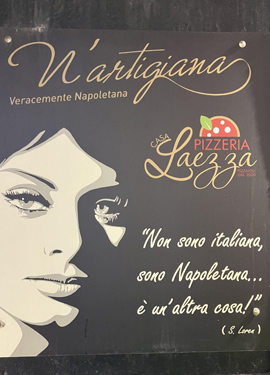
Beyond the libraries and public archives, being in the city itself was an illuminating
experience. Completely unlike any other city in Italy I’ve been to, Naples drove home
the sentiment once expressed by the actress Sophia Loren, “Non sono Italiana, sono
Napoletana! È un’altra cosa!” (“I am not Italian, I am Neapolitan! It’s another thing!”).
Naples is completely distinct in its modernity, its raucousness, and its singular
natural landscape. However, one of the most distinctive and fascinating aspects is
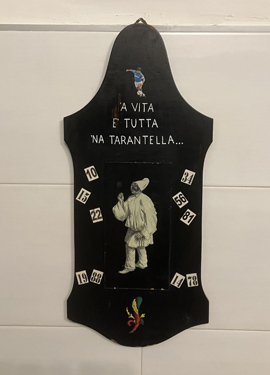
the unabashed presence of superstition at every turn. Every business had some kind
of altar or charm present, such as Cornicelli, garlic, or smorfia numbers (hung on
walls and doorways, cash registers, and the handlebars of motorbikes). This circumstance
demonstrated to me that there exists a uniquely Neapolitan perception in which the
compatibility between folk magic and modernity is completely natural. It is one of
the many aspects of culture that persisted despite centuries of colonization and compulsory
unification. I was seeing it unfold in a very contemporary context.
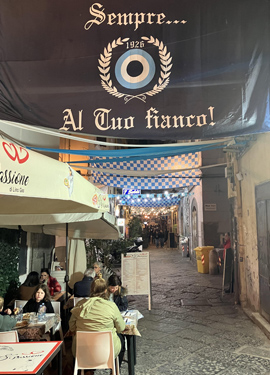
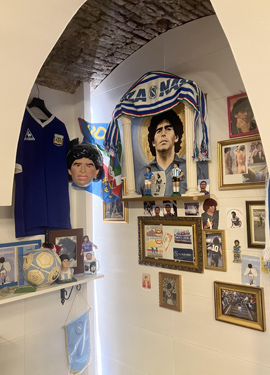
One key extension of this that made a significant impact on my research is the use
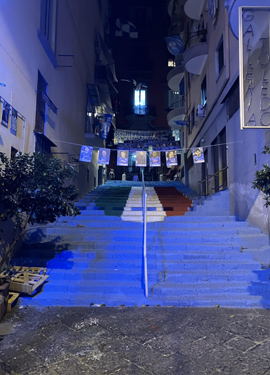
of the malocchio (evil eye) symbol as part of the crest for the flag supporting S.S.C. Napoli, which
had won a title while I was visiting. Walking through the streets, which were covered
in ribbons and streamers and lined with flags, the image of the malocchio was ever-present. It was during this time that I made a curious discovery while reading
a physical description of Rosa. The biographer described him as having blue eyes.
However, every self-portrait I had ever seen of him, he had painted himself with brown
eyes. I was shocked as I went through the art historical record and confirmed this–
with the exception of one early self-portrait, in which he does paint himself with
very dark blue eyes, he depicts himself as brown-eyed. Why might this be? One answer
surrounded me on the streets of the city– the malocchio symbol is a blue eye because blue eyes in many Mediterranean cultures, including in
17th century Neapolitan culture, were “bad luck”, an indicator of a fascinator. Perhaps
the Soldier is not singular as a depiction of a fascinator, but part of a body of work which included
Rosa’s self-portraits, in which the artist is referencing the Neapolitan impetus to
fold eye-eye beliefs into an intellectualized, modern context. This new development
lends art historical support to and expands my original argument.
This key insight and the materials I was able to access were contingent upon my presence
in Naples. Thus my experience in Naples has underpinned and shaped the direction of
my current dissertation chapter in a vital way that would not have been possible without
the
support of the Giuliani Fellowship.