Beatriz Solla Vilas
PhD candidate, Department of Hispanic Languages and Literature
Guiliano Fellow, Fall 2022
Becoming travesti: self-narrative and activism in transgender Brazilian Literature
My research journey embarked on the exploration of trans identities, particularly in the context of literary studies. As I explained in my project proposal, the intersection between trans studies and self-narrative within Latin America, specifically Brazil, remains a gap in scholarly discussions. That is why, on my trip to Brazil, I aimed to delve into the experiences of trans and travesti people. The objective was to understand how they created spaces of self-representation through autobiographies in contemporary Brazil.
Upon arriving in Rio de Janeiro, my initial plan involved conducting archival research at the Brazilian National Library and the National Archive in order to delve into the context of trans and travesti literature in Brazil during the 20th century. Given the relatively recent emergence of autobiographies within the LGBTIA+ community, finding information from the 20th century posed a challenge. However, both in the digital archive and in the library, I was able to find names for specific artists that would be persecuted during the 1970s Military Dictatorship that in Brazil, and that offered a crucial context for understanding censorship within the queer community during that period and establishing a strong foundation for the introduction of my chapter on Brazil.
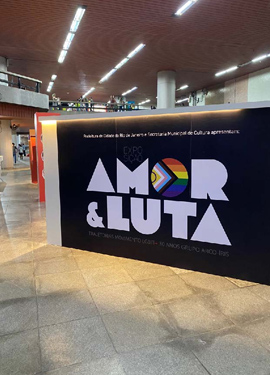
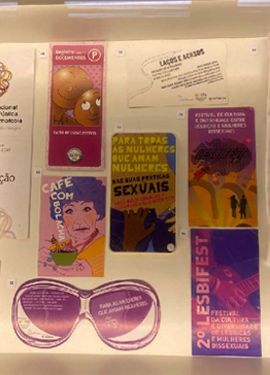
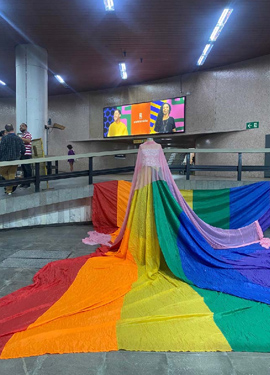
While in Rio de Janeiro, I also encountered two significant events that enriched my research. The exhibition "Amor e Luta: Trajetórias do Movimento LGBTI* e 30 anos do Grupo Arco-íris de Cidadania LGBTI+” (Love and fight: trajectory of the LGBTI+ movement and 30 years since the creation of the Arco-íris Group) provided significant insights into the political and social trajectories of the LGBTI+ community in Rio. The Arco-Íris group, dedicated to supporting queer individuals at risk and to promoting education and culture, became a focal point, providing me with a context on different cultural aspects for literary and cultural production of the queer community in Rio de Janeiro. The exhibition, complemented by different talks and events featuring members of the LGBTQ+ community, deepened my understanding the literary production in the country.
Attending the XI Congresso Internacional de Diversidade Sexual, Etnicorracial e de Gênero (XI International Congress for Sexual, Racial and Gender Diversity) at the State University of Rio de Janeiro was a turning point. Held from November 22 to 25, the congress featured insightful discussions on travesti and trans experiences in Brazil across different centuries, specifically in literature and film studies. Topics included the influence of medicine in the queer community and the politics of care for transmasculine lives. This experience significantly broadened my initial research focus on autobiographies, becoming a pivotal moment in advancing my thesis.
Finally, during my stay in Brazil from November 11 to 26, I not only engaged with historical events and exhibitions but also had the privilege of engaging with the research of contemporary trans and travesti authors and academics. Notable figures such as Sara Wagner-York, who specializes in Education, or Jaqueline Gomes de Jesus, who is a researcher and also the director of the Congress I attended, provided a valuable contemporary perspective to my research. Their insights and experiences added depth to my understanding of the evolving narrative landscape.
In conclusion, despite the initial archival challenges, my research in Brazil exceeded expectations. The encounters with both historical events and contemporary authors have enriched my understanding of travesti self-narratives in Brazilian literature. As I move forward with my research, the foundation laid during this immersive experience will undoubtedly shape the first chapter of my thesis, highlighting the initial disruption of the gender binary in Latin America. This comprehensive exploration, combining historical contexts, cultural events, and personal interactions, positions my research at the forefront of understanding and documenting the transformative power of self-narratives within the travesti community in Brazil.