


Atomic Compatible Polarization-Entanglement Sources
We develop cavity-enhanced entanglement sources, compatible with atomic quantum memories
and telecom operation. Our recent experiments have achieved 10 k entanglement-bits/s
(e-bit/s) tuned to the rubidium D1 line (795 nm). Based on tunable, high-finesse,
and portable optical parametric amplifiers (OPAs) using spontaneous parametric down-conversion
(SPDC), these sources will be capable of producing entangled photons with high brightness
at a wavelength and bandwidth corresponding to Rb atomic transitions.
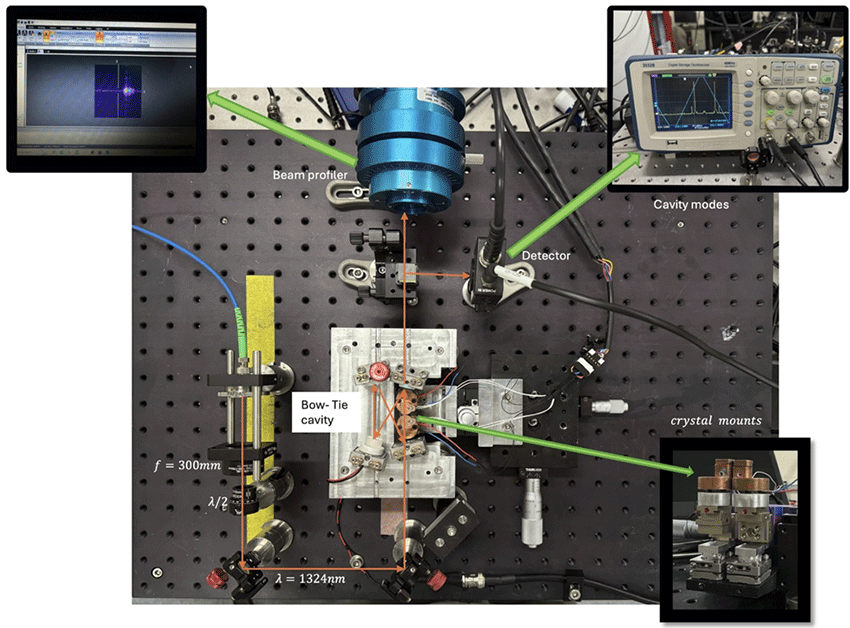
Current OPA experiment, built to the specifications obtained from ABCD matrix simulations. The experiment includes the high-finesse bow-tie cavity (center), beam mode-matching to achieve good input coupling into the cavity mode (left), spatial beam profiler to characterize the mode alignment inside the OPA cavity (bottom) and time detection setup to characterize the OPA cavity finesse and linewidth (right).
Additionally, we are also developing OPA sources tuned to the rubidium telecom bands (1324, 1367 nm). Further optimization of the photon-pair generation rate in the OPO cavity mode will be obtained by choosing an appropriate combination of high-reflectivity mirrors. In our current design, the mirrors have a reflectivity of 99.995% at 1324 nm, and the out-coupler will have a reflectivity of 99.9%, resulting in a cavity finesse larger than 5000. This will enhance the photon pair production rate (~30 MHz e-bit/s), within an OPO cavity linewidth of ~100 kHz.
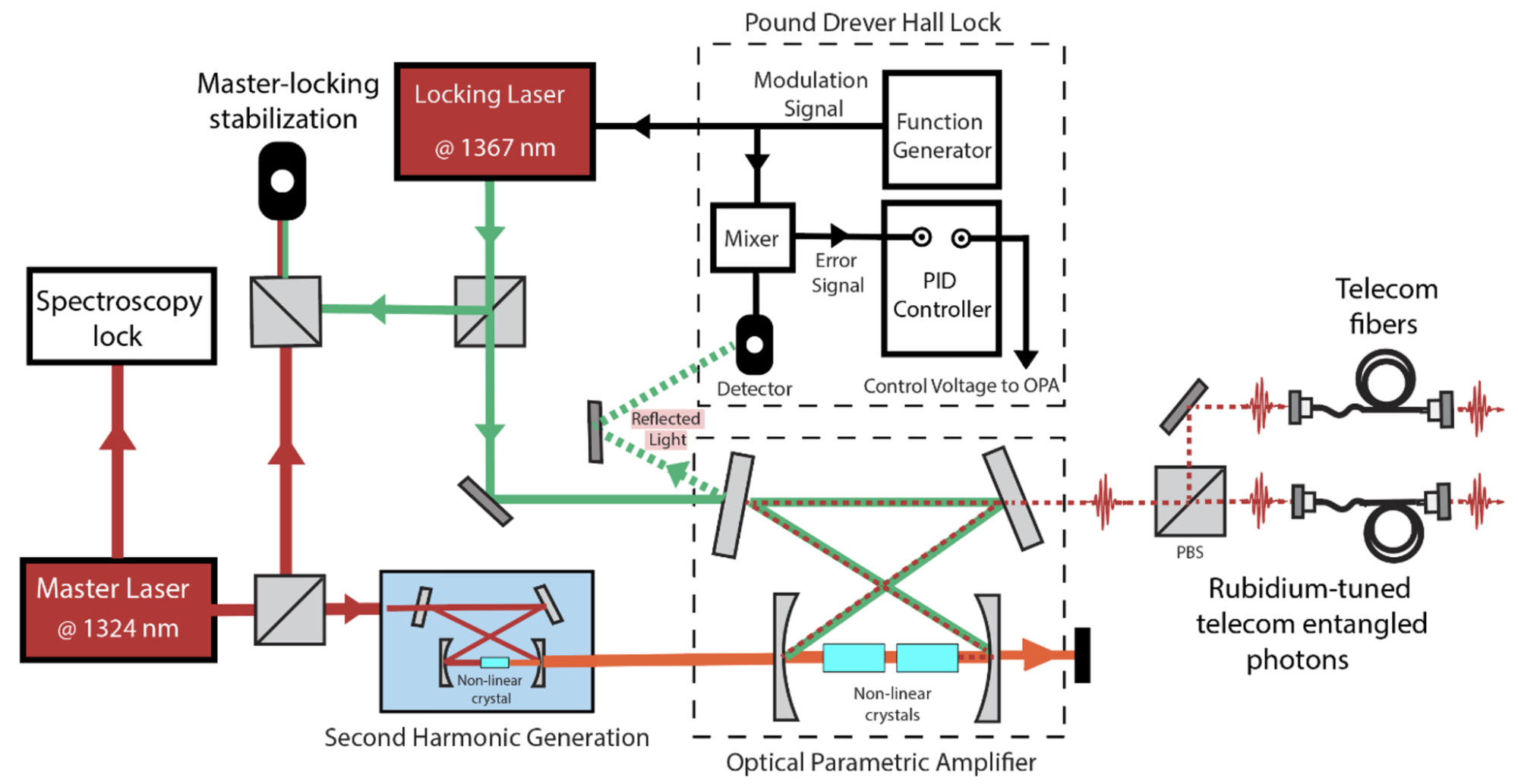
Telecom Entangled Source. A rack-mounted entangled photon pairs source working at memory-compatible telecom wavelengths. Stage I (bottom left): A stabilized laser at telecom wavelengths compatible with Rb transitions (1324 nm). Stage II (blue square, bottom): A high-efficiency frequency doubler to produce a pump laser (662 nm). Stage III (bottom, dotted square): OPO-producing cavity-enhanced SPDC photons with sub-MHz linewidths. Stage IV: Cavity stabilization electronics, including a frequency lock for a cavity-locking laser and a PDH system for cavity stabilization.
To learn more, please see Dr. Sonali Gera’s video here: